Tuesday, April 30, 2013

Olympic Peninsula Spring! Sea Run Coastal Cutthroat Trout and Summer Steelhead


 SPRING!


As it should be . . . 5/7/13 Update.

 After a scorching week of bright sun and record-breaking high temperatures here- Seattle was the hottest city in America yesterday! Up here on the Olympic Peninsula, just an hour from Seattle, we enjoy more moderate temperatures. Now we are back to a seasonably "normal' springtime weather cycle- with cool cloudy skies and daytime temperatures in the 60's. This is really perfect trout fishing weather; On the beaches, On the lakes, On the rivers. Personally, I like it like this. For much of the last week I have hidden inside, cowering from the stifling heat, eyeing the knee high weedy yard apprehensively, tying flies and waiting for the heat wave from hell to subside. Now it's time to get out there, and fire up the weed whacker, clear cut the towering grasses, and hit an late afternoon high tide. No doubt the heat wave, and bright light, really stirred things up in some of the lakes and rivers here in western Washington, and judging by all of the aquatic flies I am seeing, smeared all over my windshield, the fishing should be pretty good. Ants are in abundance now, and winged ants as well.  So I will make sure to have a few in my fly box- yes, even in saltwater- Trout love ants!

 Sometimes, especially this time of year, when they are feeding on the surface, sea runs will not like most of the flies you are offering them. They are feeding, right there in front of you, recklessly, in big splashy rises. And no matter what you are presenting, nor how you present it- they won't take it. It is likely that they are feeding on something very, very small. A size 12 to 14,(and even smaller!), black, winged ant fly just might do it. Dead drifted on and in the surface, right over those feeders. Our beaches are covered with vegetation, woody debris etc., all home to ants and other insects. Some of my fry patterns are tied very, very small for this same reason. I tie some Chum Baby flies down to size 12, and sparse, on dry fly hooks, with no bead heads, for just these occasions. (More on the Chum Baby flies can be found by scrolling down through previous postings.)

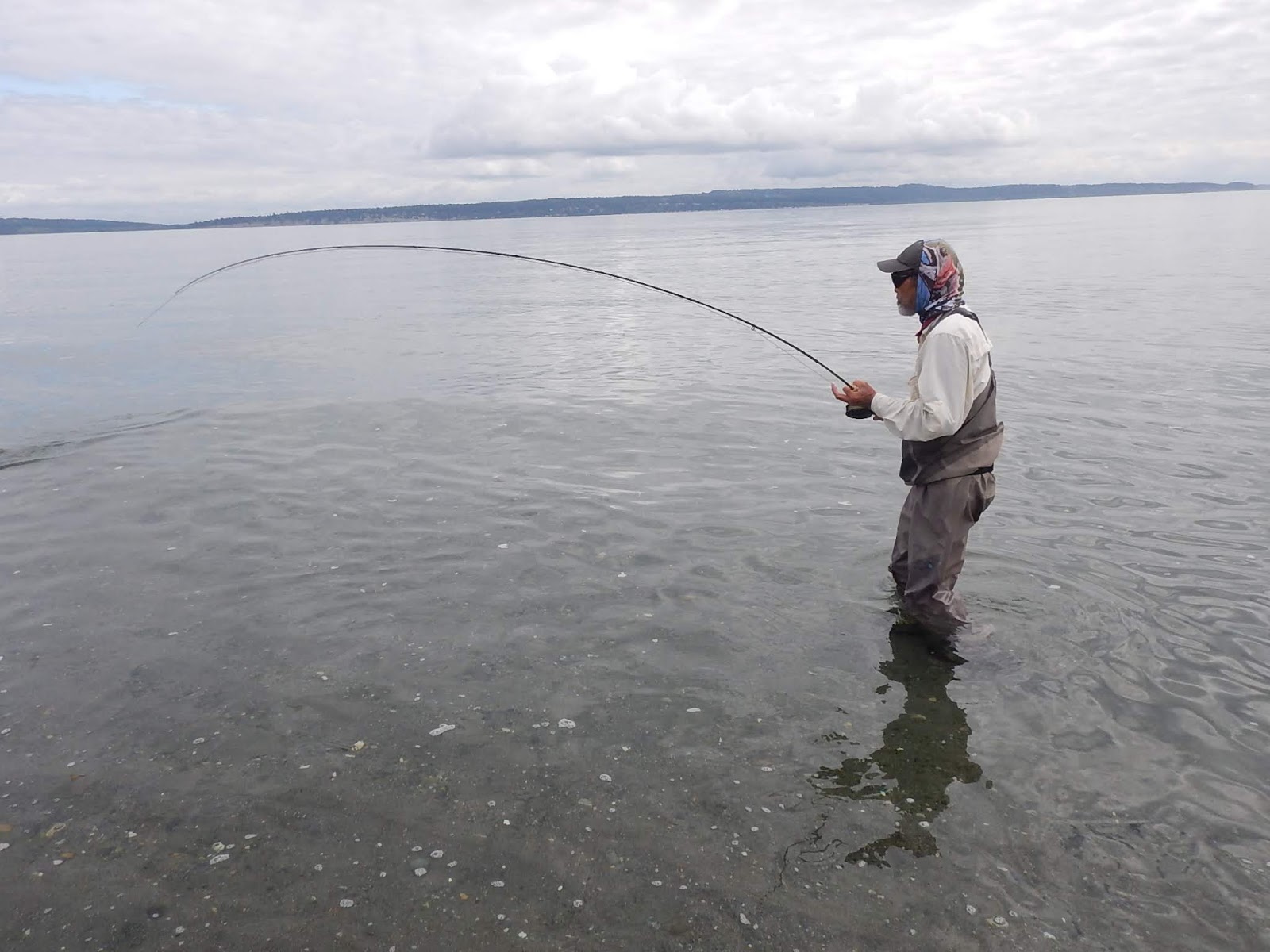
 We have had so much nice, almost-summer weather here lately, that one could easily forget that we are only entering May, and we still have June-U-Ary to get through! Don't laugh- we got sunburned on the beach one June day, and when I got home that afternoon there was hail in the roof gutters of the cabin. Beach fishing for sea run Cutthroat has begun here, with lots of sun, and  a little wind, and a few nice fish to hand last week. I have always liked May the best, as far as the timing for returning to the beaches here. By May just about all of the Cutthroat that have spawned locally have been out on the saltchuck, for a few weeks to a month or more, feeding heavily on Chum fry and juvenile forage fish, and gaining weight. By May these fish are robust and full of fight again. And it only gets better as they feed their way through spring into summer. Many of these trout are caught at the tides edges, in very shallow water, as the forage species- especially salmon fry- are taking advantage of softer currents, back eddies, and seeking tide pools along their seaward migrations. As juveniles they struggle in some of our strong tidal currents. They work hard to stay in the softer flowing edges of things. Right now I am seeing very tiny Herring in the shallows, and the Chum fry are as small as 1-1/2 inches and as big as two and a half to three inches. This reflects the fact that some of them have been in the salt water longer than others, and that the general trend is toward working their way seaward, from south to north, throughout their juvenile lives. So your fly box should have some very sparse and tiny fry patterns, ( I tie some of mine on size 12 dry fly hooks ), and some medium sized ones, and a few big ones too.


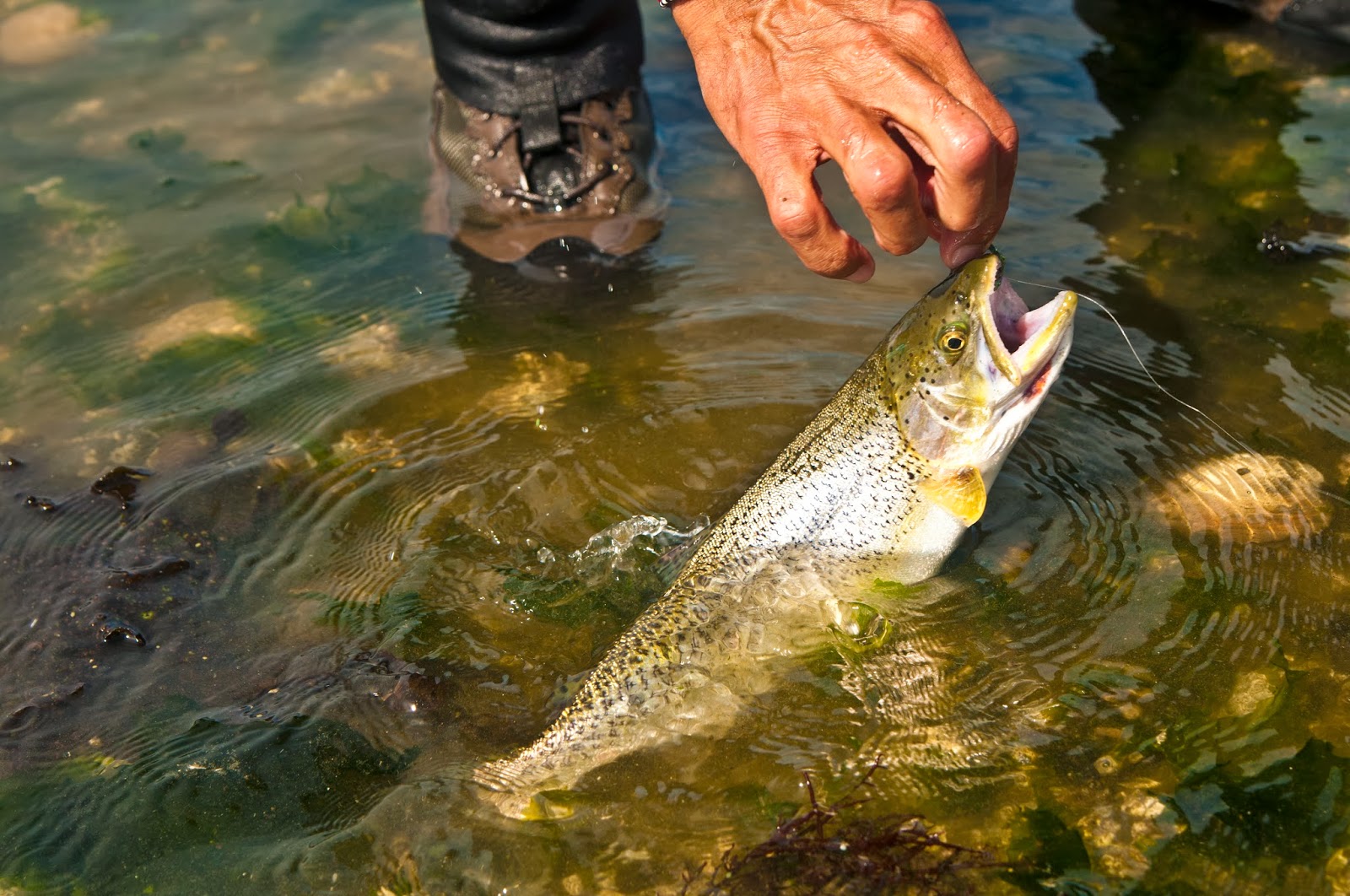
This sea run Cutthroat took a fly within ten feet of the beach, in two feet of slow moving water.


 My Little Stone's Chum Baby has been productive so far, as have some of the other flies we use, like my Beach Baby,( a good sand lance, herring and smelt imitation- size # 10 through # 6 ), and the Rolled Muddler, and Deer Hair Muddler, Knudsen's Spiders, Sculpin, Matukas etc. I always have a few of Leland Miyawaki's Beach Poppers with me too. I was tying some Chum Baby flies down at the beach the other day, in the truck, and it was really windy- enough so to bring out the surfers. Just as they hit the water our local radio station played Brian Wilson's great old classic Beach Boys hit song: "Surfing U.S.A". Enjoy!


Chum Baby Fly Tying Instructions

Little Stone's Chum Baby

 If you want to tie your own Chum Baby flies: Send $5.00 and a self addressed stamped envelope to me, and I will promptly send you back two sample flies, one small and one larger, and a two page instruction sheet to work from. Just don't let your wife catch you tying these things in her Porsche!

 Bob Triggs
 P.O. Box 261
 Port Townsend, WA
 98368

 The forecast ahead is calling for mild and sunny, warm weather here through the week. We could be enjoying summer conditions again! Last weekend we got hit with some strong winds, big new moon tides, and a pressure front change, and all of that really stirred up the waters through Monday. And the cold air that moved in was refreshing indeed. So, if anything, it has moved the fish and the forage around, and the trout will likely be taking advantage of these milder, much less windy conditions, to hit the shallows again. Around the full moon we had some big tidal exchanges, with very strong current flows, and that too will be calming down by mid week ahead. I like the softer tides around here, just before and after the new moon and the full moon, as this tends to allow the forage fish to hang around more, with less current to carry them away. If they go- the trout go with them. If it gets sunny and bright, which is exactly what we expect, then be prepared for sun exposure. The Olympic Peninsula is one of the few places I have ever fished where you can get hypothermia from the waist down, and sunburned from the waist up, all on the same trip.

A pretty spring sea run to hand!

 If you want to come fly fishing on the Olympic Peninsula waters- Give me a call or an email, and we can work out the details from there. We need to plan it ahead. The beach fishing has just begun, and each month will bring new and different opportunities for saltwater fly anglers. Our summer steelhead fishing on the rivers should be good through June and well into July. We have a substantial snow pack this year, and that will provide cooling flows for the fish to thrive in all mid-summer long. Trout fishing will open in June on most of our waters, but the earlier Game Fish Season opens on the Sold Duc on May 1st. That can be a nice little interval of early trout and summer steelhead fishing in very good and fresh river flows. For a real fly fishing Odyssey: we can fish for Cutthroat in the rivers, and on the beaches, all in one day!


Bright fish on a bright day!


18 inch wild sea run! On a Chum Baby!


 Remember; Fair Chase fly fishing only, Catch & Release, One single barbless hook fly, No bobbers, No floats, No indicators.  

 Fly Casting Instruction- Single-Handed and Two- Handed rods.

 I offer private and group instruction for fly casters of any experience or ability, from beginner to expert. Learn the basic mechanics of fly casting and begin the adventure of a lifetime, or tune up your distance and accuracy casting for your next big trip. I have been teaching fly casting for over 15 years. I have been a Certified Casting Instructor, by the Wulff School of Fly Fishing, in the Joan Wulff Method, by Joan Wulff, since 1999. In the spring of 2000 I was certified under the Federation of Fly Fishers Certified Casting Instructors program, by then Casting Board Of Governors Chair, Dr. Floyd N. Franke. The lesson sessions, of two hours duration, are offered in the Port Townsend area, usually for one or two students. Lesson arrangements are made by prior agreement. 

 Bob Triggs
 Little Stone Flyfisher
 Licensed Washington State Guide
 Certified Casting Instructor
 USCG/BLS/CPR/AED/BBP/HIV/ 1st Aid Certified
    
              Celebrating over 33 years of singularly distinguished fly fishing adventure!

 Email: littlestoneflyfisher@mail.com

 Telephone: 360-385-9618 / Toll Free: 866-793-3595

 LIKE! www.facebook.com/Little StoneFlyfisher 


Monday, April 8, 2013

Winter's Last Call?


Winter's last call?


Sol Duc River, Winter green. 

Since last Easter Sunday our rivers received a good solid hit of warm spring rain, spread over a few days of time. The flows went straight up quickly. By Saturday and Sunday night, as the storms cleared, and the colder temperatures set up in the Olympic Mountain foothills again, the flows have been dropping precipitously, into a near vertically descending profile of what will, hopefully, become some very good fishing flows ahead. So if this works out it is likely going to be our propitious opportunity to swing those winter flies on the bigger water again, in these last few weeks of wild winter steelhead season. After the 15th of April we will be focused on the Quillayute River System waters- the Bogachiele and Sol Duc rivers in particular. If you want to come out here with me, you had better call in and let the boss know that you are feeling too well to work, and let's get a few days on the water here now. Get your priorities straight here please! Once the end of April comes along you will be wishing you had been a lot less responsible and provident. And you will have  a whole year ahead of you to regret not coming.

Updated 4/18-20

 Warm rains have another spike in flows hitting the rivers right now. But the short term trend is toward colder and drier ahead. We will have to watch this cycle daily now. I am hoping for a decent flow scheme by Saturday and Sunday. Your best bet right now will be the upper Bogachiele River, for better clarity, and the lower Sol Duc River, better opportunity, and even the Quillayute river, between Tribal netting schedules.

Occupy Skagit!


Kush came down from B.C. Please, someone, give this man a cigar.

Some very good people have worked hard on this issue- to reopen the late winter steelhead Catch & Release fishing season on the Skagit River. In an effort to engage the mangers in WDFW and the Federal agencies involved, and to work within the Endangered Species Act requirements, these people have organized to call attention to the issues involved, and to present a case for reopening before the WDFW Commissioners, including public testimony at the next Commission meeting on this coming Saturday. None of this is simple or easy. And of course it involves several layers of regulation and bureaucracy. And as one great veteran of the Skagit River steelhead fishery said: "Without enforcement this will mean nothing". And we do have an enforcement deficit as the budgets cuts have defunded everything from mother's milk to coffin nails now. Last Saturday some of us gathered to support this cause, meeting up at the Howard Miller Steelhead Park in Rockport for a rally. This was a great turnout with good media support. And a few of the great names in pacific northwest steelheading came to lend their support. It would be great if you would do a little reading up on this here, and please consider lending your support in some form.

Saturday April 13th will be another effort as the Occupy Skagit gang heads down to Olympia for the WDFW Commissioner's meeting. Come, Speak, Support!

www.facebook.com/OccupySkagit.

www.goskagit.com/all_access/catch-and-release/article_802402cb-4dde-5551-be49-a8e28aaba3a0.html

As many of you may know, our Olympic Peninsula rivers are being clobbered now, especially on the weekends, as so many hundreds of additional anglers have come out here to focus on these last great wild fish. Through the entire season this adds up to thousands of additional angling hours and days hitting the water. One Friday recently we counted over 50 drift boats and hundreds of anglers on the Hoh river alone. (now you know why I prefer guiding on weekdays here.) A scenario that is becoming all too common. And this has always been a major reason behind my decision  to have avoided using rafts and boats on my trips here. We can walk in and get to some nice water ahead of the boats. And we can relocate to new water at any time, even to another river, often much more quickly than a drift boat can. And we avoid a lot of the snarky behavior that is so commonly displayed now, and not just by the guides. These rivers are not mine, and they are not yours- they are Ours. It is supposed to be fun people!

This is why I am supporting Occupy Skagit: I am sure it will reduce the overwhelming fishing pressure that we are seeing here on the Olympic Peninsula rivers sometimes now. Why the hell WDFW did not plan for this in advance, when they closed the Puget Sound regional rivers to late winter fishing under the ESA listings, is beyond me! How could they not foresee this great influx of fishing pressure here, or not mitigate it at once? Not a few of these people are coming here to continue to kill wild steelhead too. It seems like the managers always wait until it is too late to benefit from more conservative measures. And instead of using Catch and Release as a stable, wild fisheries management tool, they use it as a last ditch effort to keep fishing open, and for keeping the license and sales tax dollars flowing. Catch and Release is not a fisheries recovery tool generally speaking. It is a management tool- when you have stable numbers of fish to begin with. Some very qualified people do feel that the Skagit system steelhead numbers have been stable enough, for some years running, to support  a responsible C&R fishery there again. This would give our rivers and fish a much needed break.

On the ferry to Occupy Skagit!

 
On the Saltchuck


Evening tide.

P.S. The Chum salmon fry are moving into our area now! I have been letting the cutthroat fatten up on them a little bit for now. But it will be very soon that you will have to haunt the beaches at dawn to find me. Once I see the Salmon Berry blossoms along the steelhead rivers here, and the Hummingbirds buzzing about, and the brief, intermittent  hatches of Blue Winged Olives, Crane flies and Stone flies- I feel this pull inside of me to get salty again too. I am suspended somewhere between winter and spring, steeped in the overwhelming beauty of life and nature, as one season ends and another begins. I wouldn't mind if we had another 60 days of winter, and wild steelhead fishing to revel in. But spring is so exciting, so sudden, that it alarms the senses. And last night I went for a walk at 7:30 and it was still light out. I am so ready for that.


It's Chum Baby Time . . . Again!


More Chum Baby flies are on their way to the Orvis Bellevue Fly Shop! Just in time for your spring Puget Sound Saltchuck fly fishing adventures! This well tested and proven fly pattern has been very productive on our regional sea run Coastal Cutthroat trout. And many other fisheries are seeing success with this fry pattern now; In Alaska, New England and beyond. A great general spring time fry pattern. And not just for trout- Dolly Varden char and  Smallmouth bass fly fishermen are doing well with this fly too. One of the fun aspects of developing a fly pattern is to see how other fly fishermen will use it over time, across the range of possibilities. And to see it work in salt waters and fresh waters, including still waters, is a real kick.

Tie your own!
To receive two of my original Chum Baby fly samples, and my two-page detailed tying instruction sheet:
Send $5 and a self Addressed Stamped Envelope to:

Bob Triggs
Box 261
Port Townsend, WA
98368

I will send them right out to you!

I look forward to helping you plan that last winter steelhead trip out here on the Olympic Peninsula with me, or maybe you are as excited about our sea run Cutthroat Trout beach season as I am- mid to late April through November- and we can talk about that too. Catch & Release, Fly Fishing Only. Fair-Chase; swung flies, one single barbless hook, No Bobbers, No Indicators.

Bob Triggs

Tel: 360-385-9618 / Toll free: 866-793-3595

Email: littlestoneflyfisher@mail.com

Like! www.facebook.com/LittleStoneFlyfisher


Friday, March 22, 2013

Cold Is Good!


Cold Is Good!
 By this first week of spring every year most of us are praying for warmer, sunnier weather. After so many weeks of scattered storms and warm rain events, and losing fishing days to high water, we are finally getting a serious cold snap that has the river gauges plummeting into reasonable numbers that represent some days of good fishing conditions ahead. It is snowing here as I write this, on the third day of spring. And the Sol Duc is turning that deep, jade green color again now too. Very little precipitation ahead in the short term forecast, and freezing levels at or below 1000 feet. After the last spike in flows this is one of those times when you want to be there- for the pregnant possibility of ocean bright wild fish that have taken the express ride up the rivers, unfettered by boats and nets in the higher flows. So we'll bundle up, stay warm, and go steelhead fishing.

Counting Spawning Coho (late December)


 Here is Dr Cliff Mass recent blog on this cold event:

 Dr Cliff Mass Pacific Northwest Weather Blog  This is a good page to be aware of as he posts interesting stuff on our regional weather, and he tries to keep up with significant events as they occur.

 The later we get these cold weather periods in spring time the better our snow pack will be in the mountains all summer. We get some prolonged dry weather here, often the driest place in the country each summer. It is kind of ironic considering that the Olympics get some 140-180 inches of precipitation every year. This new snow and ice in the higher elevations is vital to spring spawners, cutthroat and steelhead and salmon redds, and just about everything else. Adding energy and life to river flows well into late summer.

 There has been some light insect hatching activity observed on occasion, blue winged olives mostly, some smaller stone flies, and quite a few crane flies at times. And even out here on the Olympic Peninsula we see some skwalas each spring. It wont be long before we see the cutthroat chasing them, once it warms up again that is. But I can wait for that day. We have fully a month of winter steelhead season ahead of us here now, and I can wait for cutthroat fishing until late April anyway. By then we'll be chasing them on the beaches again, as they converge to feed  on the chum salmon fry in the shallows. Right now I have that urgency of mind over the last weeks of winter steelhead season, which always comes too soon. Some winters are like that.

The Cutthroat are spawning here now.


 The water is cold here now, so your fly needs to be moving deep and slow. Line handling skills and reading the water will be the key. Sometimes you might need to mend your cast to slow down the fly. Other times you might need to keep a fairly tight line to the fly throughout the swing. It all depends upon the flows that you are in at the moment. And around here each run has many changes in depth, speed, etc. You really do have to pay attention to depth and speed all day. Let that be the best part of the work. And it will be far more helpful, and enjoyable, if you allow yourself to cast comfortably, whatever range of distance you can handle, rather than stressing out over a perceived need to cast across the river on every presentation. Covering thoroughly, whatever water that you can, is by far the best strategy. You would be amazed at how much wasted time all of those extra casts and strokes can take up in a day.  And your fly needs to be in the water working, not zipping back and forth in the air all day.

 I do carry some of the big, ugly winter flies in my fly box, ones that have become so popular at this time of year here. But it does not hurt to have a few smaller flies too, down to size 6 and even size 8. You might hit a soft spot that will allow you a very light presentation, even before the flows have dropped significantly below the averages. I like the soft hackled flies and hair wing patterns for this. This time of year I am using #12 to #16 tippet as we do see some bruiser big fish in late winter. Sure, we could land a big fish on 10 pound test. But we do not want to over play or over stress these wild winter steelhead. We want to release them without avoidable injury, and allow them to spawn successfully. Learning how to play and land big fish on a fly rod takes time and experience. Be patient. Fly fishing is a life game, a practice, not a lottery payout. Still: " You can't win if you don't play."


Easter on the Sol Duc.

If you want to come, give me a call or an email. We need to plan it ahead of time. I will usually get back to you within a day. I am happy to help you make your plans for Olympic Peninsula winter steelhead fly fishing. We walk and wade on a few nice locations in a day, fishing them well and enjoying it thoroughly. We might fish on more than one river depending upon conditions. This is very easy to accomplish as we simply drive to a new location, often within minutes. Most of our rivers do have roads nearby. We fish on the swing, traditional fair chase fly fishing only; Catch & Release, Single Barbless Hook Fly, No indicators, No Bobbers, No added weights etc. If you want to make the commitment, I am willing to help you. Spey fishermen are especially welcome. Full support assured in any case, with over 33 years of fly fishing experience.

 Bob Triggs
  
 Telephone: 360-385-9618 / Intl Toll Free: 866-793-3595

 Email: littlestoneflyfisher@mail.com

 Like Me On Facebook!: www.facebook.com/LittleStoneFlyfisher

Saturday, March 16, 2013

Gratitude


Gratitude
 I took a drive over to the beach yesterday, I rigged up my rod with a new intermediate sink tip line, and I tied on a Chum Baby fly to try out on the incoming tide. It was a beautiful sunny afternoon, with a soft and balmy southwest breeze coming in, and the water was in good shape. I was thinking about Doug Rose most of the time, remembering so many good moments and great shared conversations, and wishing that we had spent more time together, and that we had more time to share. I don't think that I will ever be able to fish a pacific northwest  beach without thinking of him now. I swung the fly in the current for a few hours, not catching anything, but thoroughly enjoying the warming sunlight and the sweet pungent smells of the rising tide as it pushed into the gravel shores and mudflats. That is a great sign of spring- the fresh smell of of the saltchuck coming to life beneath the warming sun under the mid-day low tides. Each tide ahead will bring a freshening energy of nutrients to our near shore and inter tidal areas, into the great pocket estuaries and lagoons. You can feel it in the air- the great expectancy for the coming season of renewal, life and hope. I find myself clinging to Doug's wise admonition- that we remember to seek Grace in our time on the water. In my own experience, you can not find it by seeking. You have to be open to it. And when it comes, it is a memory of something True that was always there. And you find yourself wondering how the hell you ever missed that.

Tying Chum Baby flies on the steering wheel vise

 Wading the shallow edges I poked around along the way, turning over shells and debris and seaweed, looking at the myriad lives emerging into the season. There were plenty of starfish, sculpin, snails, crabs, shrimp, squirting clams, midges and gnats, and the birds are everywhere. I have known 13 generations of eagles here. Wading way back in the big lagoon I saw no Chum salmon fry yet. But they will be here soon. And no doubt there could be a few that I simply missed. I see them dropping out of the Hood Canal rivers as early as the first week or so of March. And I have a hunch that after milder winters, like this one, when we have had so much more sunlight, they may get out of the smaller waters a bit earlier. One advantage to living here is that during winter steelhead season, between the storms and spates, when my spey fishing river trips are on hold, I can walk these Olympic Mountain Rainshadow beaches, often in remarkably calm and relatively dry weather. Doug and I have swapped stories on the good sea runs that we have caught in the dead of winter this way.

Between Tides


 Everywhere I went yesterday were the signs of recent winter storms that change everything each year; New logs drifted in and settled  as older logs were carried away on high water, large drifts of stone, gravel and sand have overturned in the crashing waves and currents of the strong southwesterly blasts, reshaping the shoreline, revealing new patches of peat layers, filling in the deep places and scouring out the shallows. Every spring the beaches here change, creating new flows and new fishing opportunities. I like to walk the beaches at the lowest water, during the incoming tide, and find the nuances to these often subtle changes. The fish will find them all too. It is impressive how little a change in the topography of these beaches can lead to an entirely new approach to our fishing all summer and fall.

 The last time that I saw Doug was on this beach last fall. We sat on a great old weathered beach log and talked a while. We shared a mutual passion for this vast wild place, and for the fish, and the fly fishing, the history and the people, and so much more. And likewise we agreed on the observation that our regional wild fish management policies were significantly behind the times. One thing that Doug did not do was hold back when it came to his acerbic observations on the ironies of how our wild fish are "being loved to death now", even by the "fly fishing industry". As much as he was at the core of the celebrity life of professional fly fishing, and his seriously qualified authorship of so many widely read works, he thoroughly disdained the hype. Doug's life here encompassed a great breadth of involvement and experience on many levels. His enthusiasm was inspiring. His contributions to our lives here will be felt forever.

 When I first came here to live, Doug was one of the few fishermen to welcome me and to so generously share his appreciation and experience of fly fishing here with me. And in the ensuing years, as I grew in my own experiences here, we were always trading ideas on fly fishing, especially for sea runs; sharing observations on seasonal shifts, forage, flies, and more- all of that nitty-gritty stuff that keeps fly fishermen awake at night. It seems that all of our friendship was spent in brief stints of intense conversation. There was always a sense of urgency, that we had so much to share and hear between us, and just a little time to do it. We were usually both busy. Even when he was guiding on these same waters, or leading a small group outing, he always made time to stop and connect with me. And sometimes we quickly worked out the immediate etiquette of guiding our fishermen together, in the same place, with never a hitch. Doug had a very solid way of being, with integrity, and depth. He valued the simple things, and worked within the deeper things as well. No one has done a better job of lassoing the Olympic Peninsula fly fishing experience than he has- through his decades of adventurous angling, his many books, articles and essays, and his impressive blog.

 Doug Rose was our brother angler. And he was our great Champion of the wild waters and wild fish here, and a strident voice for ethical management and wise stewardship. If you have not read him, get started now- his words have a forever living soul: www.dougroseflyfishing.com


New Life


 And the more that I think about it now, It seems like most of our best conversations were held right there on the very same beach. Sometimes we were fishing. Sometimes we were just being there. So many good words and thoughts, laughter and musing. That log that is so good for sitting and sharing has not moved, despite having been pounded by over a decade of winter storms. Maybe you too will find your way out to that beach one day, just to sit in the sun and remember Doug. And if you love the wild fish and bright waters as we do, you will be welcome here anytime. Gratitude.

Bob Triggs
Little Stone Flyfisher
littlestoneflyfisher@mail.com
360-385-9618
On Facebook: Little Stone Flyfisher- Guide

Tuesday, March 12, 2013

Doug Rose Has Died


 This is likely one of the harder notes I have to write here. Good friend and mentor, Author and Guide, our champion of wild fish and bright waters- Doug  Rose has died after a brief illness. I need a little time to digest all of this. And I will share some thoughts and feelings of Doug's friendship and generous spirit here soon. For now I will say that the outstanding impression that I have always had of Doug Rose was that he sought Grace in all things. I will miss his frequent blog postings and fishing reports, and his articles on the fishing, natural history and lore of this region. And I will especially miss seeing him on our waters. You can read Doug's many blog offerings on his website at : www.dougroseflyfishing.com

Sunday, March 3, 2013

It's Chum Baby Time!!!


Little Stone's Chum Baby


 Chum Baby flies are Now available at the

Orvis Bellevue Fly Shop.

 This fly has become a very well known, popular and successful pattern for sea-run Coastal Cutthroat trout fly fishing on Puget Sound regional waters and beyond. I worked this fly up over several seasons of trial and error on my local beaches. After catching many sea runs on it from late winter through early summer, from the north Olympic Peninsula and Admiralty Inlet to the Hood Canal beaches, I knew it was a winner. I originally intended the Chum Baby as an imitation of our out migrating juvenile Chum salmon, which are plentiful here along the shallow and warmer near shore areas, pocket lagoons and estuaries in early spring, and the trout eat them aggressively.

 What has come as a happy surprise is how well this fly can work at other times of year here, even when there are no Chum salmon fry around. And I use it in our rivers and streams too. Even in the fall. Some people are using this fly on the Skagit system for Dolly Varden in the spring  And now many of my fly angling friends and fellow guides are using this as an all-around fry pattern; in Alaska for Rainbow Trout, Dolly Varden, Arctic Char and Grayling, and on the Atlantic Coast for "Coaster" Brook Trout and Striped Bass. We are also using them on Snook, Redfish and Sea trout down south. This has been a very fun thing to watch evolving. And sometimes we need to remember that this whole fly fishing thing is supposed to be fun.

 The Chum Baby fly can be presented using a wet fly swing, dead drift, cast and strip, fast, slow, shallow or deep- as needed. One thing that you will notice about it is that the wing really lights up under water with even a small amount of sunlight. And the sparser you tie them the better this works. Juvenile salmon and other forage fish are not opaque underwater, they are semi transparent. The distinct dark peacock herl collar on this fly is meant to emulate the eye of  a chum fry. The glittering tinsel body is to imitate the gut and the two crystal flash strips represent the lateral line. The barring of the natural Fox Squirrel tail wing seems to work very well, even though most of the Chum salmon fry and older juveniles you see will be subtler in color, spotted, and usually more on the green, olive brown side. The peacock herl topping is simply because I am old fashioned, and I try to include some of the more traditional features of old world patterns in my flies. All in an impressionistic effort. Strictly speaking we can call this fly an "attractor" pattern.

 I tie them sparsely in the early spring, March and April, at under two inches long overall. By May and June I tie them much longer, and with a larger bead. They can be tied with a smaller hook, size # 8 or #10, and with a much smaller wing etc. But if I am tying it larger I do not increase the hook size above #6 as we are trying to avoid injury to these precious wild trout. I like these medium shank length hooks as we tend to get good hook ups, with only very rarely any deep hooking or tongue injuries this way.

 The Chum Baby Challenge! Every year for some years running since I created it, I have shared this fly with my fishing guests and friends. And I make this offer: Take this fly and fish with it- wherever you go, whatever you fish for. And take some pictures of these fish. Send me the pictures, with your information and fishing story. Each new species caught gets entered into the annual Chum Baby Challenge. And at the end of the year I draw from those names, and  the winner gets a box of my own hand tied flies. And I will post the picture and your story here at the end of the year.

 If you want to tie your own Chum Baby flies, and if you would like to have a tying recipe and model flies to begin with:

Send me $5.00 and a Self Addressed Stamped Envelope, and I will send you back two original Chum Baby flies, hand tied by myself- one early season fly and one later season fly- along with a tying instruction page that you can work from to tie your own. And if you would like me to send you an email version of the tying instructions please include your email address as well. Print all neatly and clearly.

Send To:

Bob Triggs
P.O. Box 261
Port Townsend, Wa
98368

 We'll be getting back to our Olympic Peninsula winter steelhead fly fishing very soon if this cold weather continues to draw down the recent higher river flows here this weekend. We anticipate that some new fish will be moving upriver on the fresh flows, and that the runs will just get that much better. We don't ever like to cancel our trips, even though we will always reschedule them, but we really needed the rain. Time to start tying our spring sea run Cutthroat flies! I can taste the salt already. More of my original fly patterns will be shared here soon.

For trip information contact:

Bob Triggs

Phone: 360-385-9618 / International Toll free: 866-793-3595

Email: littlestoneflyfisher@mail.com

Like me on Facebook! Little Stone Fly Fisher- Guide


Friday, March 1, 2013

Short and Sweet: Too Warm, Too Wet


Pineapple Express


This most recent incoming south Pacific "Pineapple Express" slammed through here over the last 24 hours, nudging into the Olympic Mountains on it's way to Vancouver Island and B.C., and spanked us with plenty of warm rain. This has affected all of our Olympic Peninsula coastal rivers and left us with dirty and high flows, and no immediate fishing plans for a little while as we wait for colder temperatures in the lower elevations to return. For your interest and toward a better understanding of how these things work, here below is a link to Dr Cliff Mass's blog and his comments on this unusually strong and sudden event. I will be tying flies for now. Maybe we will be fishing again later next week. Stay tuned.